Whether it is a biosafety cabinet, a laminar flow hood, a PCR workstation or a ductless fume hood, every laboratory enclosure depends on filtration to do its job. But not all filters work the same way, and confusing one type with another can leave people and samples unprotected. Understanding what each filter does (and what it does not do) is essential for not only selecting the right enclosure, but properly maintaining it and knowing when a filter change is overdue. This guide covers the four main filter types found in laboratory enclosures, how they work and how to keep them performing.
From this blog, you will know:
- the distinction between the four filter types
- when to specify a ULPA filter over a HEPA filter
- why pre-filters can extend HEPA filter lifespan
- how activated carbon filters adsorb chemical vapors
- when each filter type needs replacing
🛒 Prepare for big savings this summer! Coming this June, enjoy 15% off all AirClean Systems products, including ductless fume hoods, PCR workstations, laminar flow cabinets, and more. It’s the perfect opportunity to upgrade your lab with trusted clean air and containment solutions while maximizing your budget. More details on this limited-time promotion are coming soon, stay tuned!
HEPA, ULPA, Carbon and Pre-Filters
In a typical laboratory enclosure, filters are arranged in a deliberate sequence that reflects their role. In biosafety cabinets and laminar flow hoods, the HEPA or ULPA filter is positioned directly above or behind the work surface, delivering clean air as the final step before it reaches the workspace. The pre-filter sits at the point where air first enters the filtration path, (usually behind a front grille or at the air intake) that allows it to intercept coarse debris before it can reach the more sensitive filters downstream.
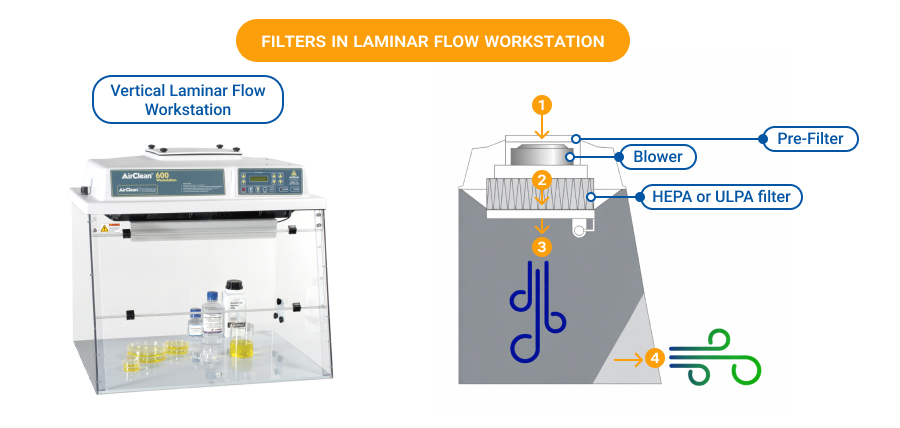
1 - Room air enters and is cleaned via electrostatic pre-filtration. 2 - Air then moves downward through the HEPA filter. 3 - Clean vertical laminar flow air enters the chamber. 4 - Clean air is recirculated into the room.
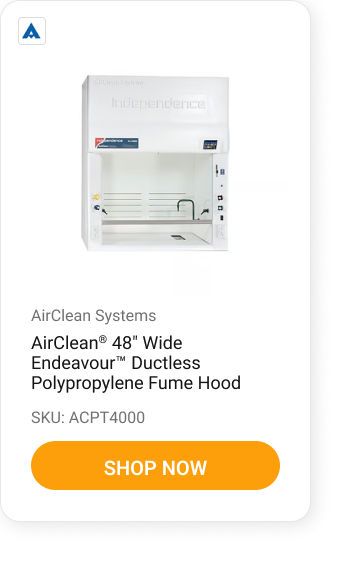
And in ductless fume hoods, the activated carbon filter sits at the top of the unit after the pre-filter (and after an intermediate HEPA stage in multi-layer systems) so that the recirculated air returned to the laboratory has been stripped of any chemical vapors[1].
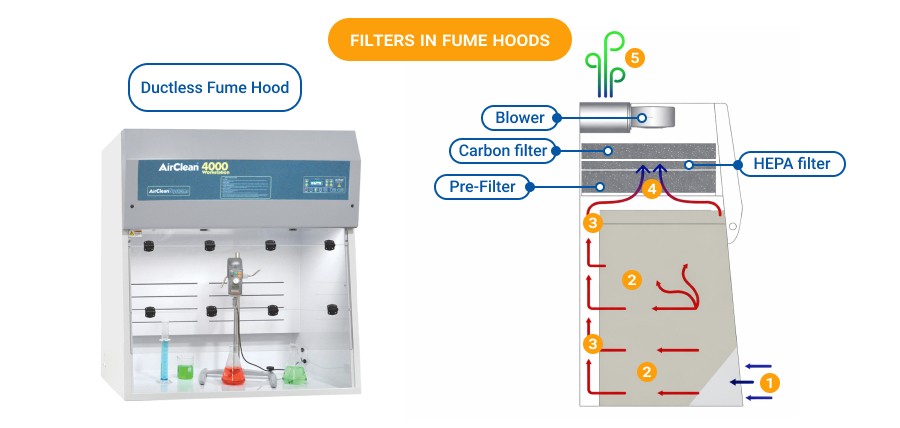
This layered arrangement ensures that each filter handles only the contaminant type it is designed for, and that upstream filters protect downstream ones from premature loading.
The Gold Standard for Particle Removal - HEPA Filters
High-Efficiency Particulate Air (or HEPA for short) filters are the critical filtration component in biosafety cabinets, laminar flow hoods and HEPA-equipped PCR workstations. A HEPA filter captures airborne particles like bacteria and fungal spores with extraordinary efficiency. Unlike a simple sieve, HEPA filters are constructed from a dense mat of randomly arranged borosilicate glass microfibers, pleated to maximize surface area within a compact frame. This allows to capture particles through four distinct physical mechanisms that work together across all particle sizes[2]:
- Inertial impaction: Larger particles (typically >1 µm) have too much momentum to follow the airstream as it curves around a fiber, so they collide with the fiber directly and stick to it
- Interception: Mid-sized particles follow the airstream closely but pass within one particle radius of a fiber, making contact and adhering to it
- Diffusion (Brownian motion): The smallest particles (≤0.1 µm) move erratically due to collisions with gas molecules, causing them to wander into fibers at rates that increase as particle size decreases
- Electrostatic attraction: Charged particles are drawn to oppositely charged fibers, enhancing capture across all size ranges
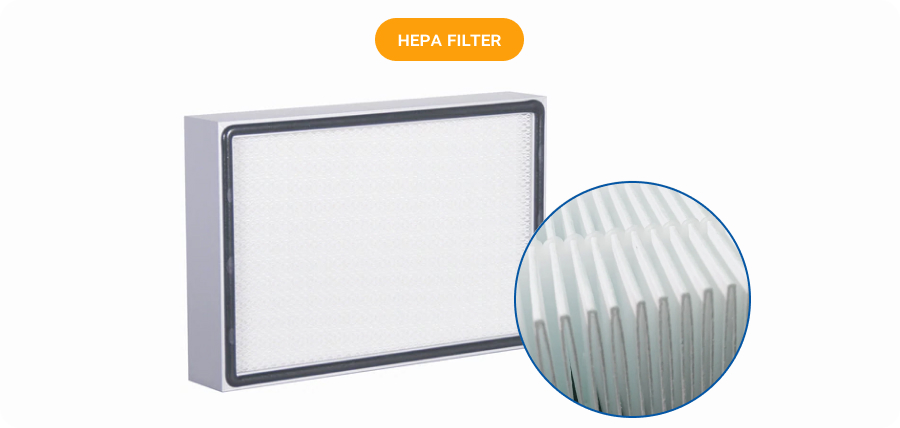
By definition, a true HEPA filter must remove at least 99.97% of airborne particles at the most penetrating particle size (MPPS) of 0.3 µm[3]. This occurs because particles smaller than 0.3 µm are trapped by diffusion, while those larger than 0.3 µm are caught by interception and inertial impaction, leaving this middle ground with the lowest capture efficiency.
The 0.3 µm specification represents the worst-case particle size - the point where the combined efficiency of all four mechanisms is at its minimum.
ULPA Filters - When HEPA Is Not Enough
Ultra-Low Penetration Air (ULPA) filters offer even higher efficiency than HEPA: 99.9995% capture at the 0.12 µm most penetrating particle size. They use denser fiber media and tighter packing to achieve this performance, which comes with trade-offs: higher airflow resistance (meaning the blower motor works harder), a shorter operational lifespan (typically 5-8 years versus HEPA’s 5-15 years), and higher cost[4].
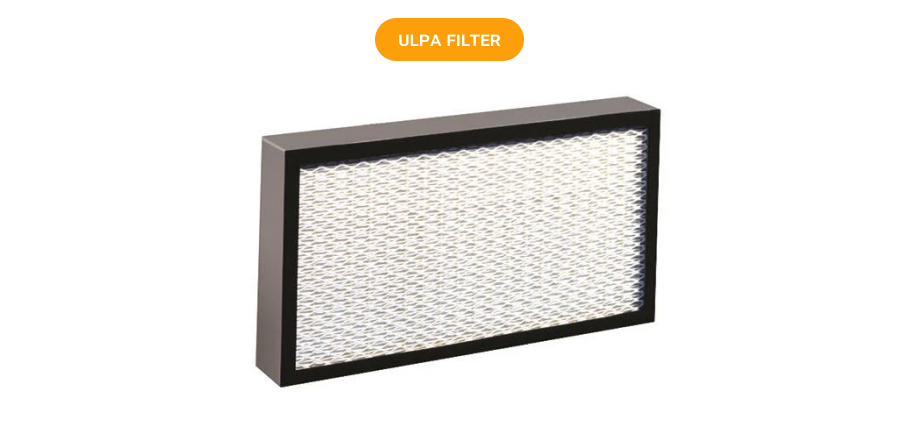
In practice, ULPA filters are used in applications where even HEPA-level filtration is insufficient. These include semiconductor fabrication cleanrooms, certain pharmaceutical manufacturing environments, and sensitive biomedical assays where the work demands the lowest achievable particle counts. Some advanced PCR workstations also offer ULPA filtration as an option for forensic DNA or ancient DNA work, where eliminating even trace environmental particles can be critical.
For most standard biosafety cabinets (BSC) and laminar flow hood applications, HEPA filtration is more than adequate. The North American standard for BSC certification - NSF/ANSI 49[5] - requires HEPA-level performance, and the vast majority of BSCs sold worldwide use HEPA filters. Specifying ULPA where HEPA would suffice increases operating costs and may reduce cabinet lifespan without meaningful safety benefit.
Pre-Filters: The First Line of Defense
Pre-filters are coarse-grade filters positioned upstream of the primary HEPA or carbon filter. Their job is straightforward: capture large airborne particles like dust, lint, hair, and other debris before it can reach the main filter. By trapping this coarse material early, pre-filters significantly extend the service life of the more expensive filters downstream. Filtration efficiency for pre-filters is rated using the MERV (Minimum Efficiency Reporting Value)[6] system that ranges from 1 to 16, with higher numbers indicating finer filtration. A typical laboratory enclosure pre-filter falls in the MERV 6-10 range, capturing particles in the 1-10 µm size range with moderate efficiency.
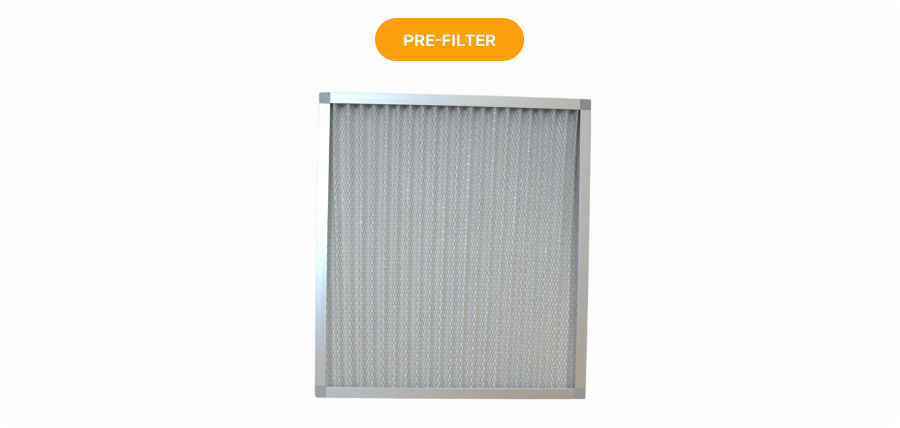
Pre-filters do not provide the sub-micron particle capture needed for aseptic work - that is the job of the HEPA or ULPA filter behind them. However, research from the U.S. Department of Energy has shown that regularly changed pre-filters can extend HEPA filter lifespan by up to four times if inspected regularly[7]. A clogged pre-filter restricts airflow across the entire enclosure, which can reduce containment performance in a BSC or compromise the clean air supply in a laminar flow hood.
Most manufacturers recommend visual inspection monthly and replacement every three to six months, depending on the laboratory environment.
Capturing Chemical Vapors with Carbon Filters
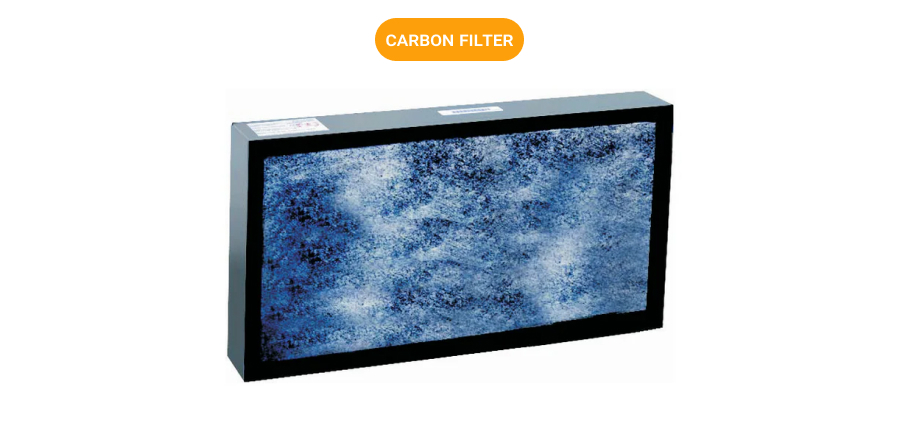
Activated carbon filters are the primary filtration technology in ductless (recirculating) fume hoods. Unlike HEPA and ULPA filters, which capture particles, carbon filters adsorb chemical vapors and gases through a process driven by van der Waals forces - weak intermolecular attractions that pull gas molecules onto the carbon’s vast internal surface area[8]. A single gram of high-quality activated carbon (typically derived from coconut shell) can have an internal surface area exceeding 1,000 square meters.
How Carbon Adsorption Works
Activated carbon is produced by heating carbon-rich raw materials like coconut shells, wood, coal or peat at high temperatures (500-1,100°C) in a controlled atmosphere to create a highly porous structure. The resulting material is riddled with microscopic pores that trap chemical molecules as contaminated air passes through. This process is called physical adsorption - molecules are held on the surface by intermolecular forces, not by a chemical reaction.
Not all chemicals are equally suited to carbon adsorption. As a general rule, compounds with a molecular weight above 30 and a boiling point above 60°C are good candidates[9]. Very light or volatile molecules (including some common laboratory gases) may not be captured reliably.
This is why manufacturers publish chemical compatibility lists for their ductless hoods - and consulting those lists before use is essential.
Combination and Multi-Layer Filter Systems
Many modern laboratory enclosures use multi-layer filtration systems that combine several filter types in sequence. A common configuration in advanced ductless fume hoods is:
Pre-filter → HEPA filter → Primary carbon bed → Secondary specialty carbon → Safety backup filter
The sequence matters - the pre-filter and HEPA layer remove particles first, preventing them from clogging the carbon’s pores that could result in reduced chemical adsorption capacity.
Some manufacturers also offer specialty carbon blends - carbon media impregnated with reagents or formulated to handle specific chemical families such as acids, bases and organic solvents simultaneously. These combination filters extend the versatility of ductless hoods beyond what a single carbon type can achieve, though they still require careful matching to the chemicals in use.
What Different Types of Filters Cannot Do
A HEPA filter captures airborne particles like bacteria and fungal spores with extraordinary efficiency, but it will not stop chemical vapors or gases. A ULPA filter takes particle removal a step further with higher efficiency for applications like pharmaceutical manufacturing and semiconductor cleanrooms, though at the cost of higher airflow resistance and shorter service life.
An activated carbon filter works by using van der Waals forces to adsorb chemical fumes onto a vast internal surface area, but it cannot reliably trap biological contaminants or fine particles. A pre-filter catches coarse dust, lint, and debris to extend the life of the expensive HEPA, ULPA or carbon filters downstream, but it offers no fine-particle or chemical protection on its own.
Understanding what each filter does is essential for proper maintenance. This filter comparison chart helps summarize these differences:
|
Filter Type |
Captures |
Does Not Capture |
Typical Lifespan |
Found In |
|
Coarse dust, lint, hair (>1 µm) |
Fine particles, vapors, biologicals |
3-6 months |
BSCs, laminar flow hoods, ductless hoods |
|
|
99.97% of particles at 0.3 µm (bacteria, spores, viruses) |
Chemical vapors and gases |
5-15 years |
BSCs, laminar flow hoods, HEPA PCR cabinets |
|
|
99.9995% of particles at 0.12 µm |
Chemical vapors and gases |
5-8 years |
Pharma/semiconductor cleanrooms, advanced PCR cabinets |
|
|
Chemical vapors (MW >30, BP >60°C) |
Particles, biological aerosols |
Varies by chemical load |
Ductless fume hoods |
Understanding what each filter does is essential for proper maintenance. In a typical laboratory BSC, HEPA filters last approximately 5-15 years depending on the cleanliness of the environment and how well the pre-filter is maintained. Replacement is triggered not by a fixed schedule but by performance indicators: rising pressure drop across the filter (indicating particle loading) or failure during integrity testing.
 |
 |
 |
 |
When a Filter Change is Overdue
Filters are also not "install-and-forget" components. Pre-filters need regular inspection and replacement to keep the system performing and save on electricity costs. HEPA and ULPA filters require annual integrity testing as part of your enclosure's certification cycle. Carbon filters must be monitored for breakthrough and replaced before their adsorption capacity is exhausted. Staying on top of these maintenance tasks ensures that the protection your enclosure was designed to provide is the protection it actually delivers.
Choosing the right filter (and understanding its limitations) is just as important as choosing the right enclosure. A HEPA filter will protect your cell cultures from airborne contamination, but it will not shield you from solvent fumes. A carbon filter will capture those fumes in a ductless hood, but it will not provide the biological containment of a BSC. Each filter technology solves a specific problem, and no single filter type does everything.
At Pipette.com, we support labs with every type of laboratory enclosures and filters designed to keep your samples steady and operators safe - day in and day out.
Frequently Asked Questions (FAQ)
How do I know when my HEPA filter needs replacing?
HEPA filter replacement is typically triggered by performance data rather than a fixed calendar. Performing integrity testing helps verify the installed HEPA filter has no leaks - from pinholes in the media, damaged frames or faulty gasket seals. The standard method is the PAO (Poly Alpha Olefin) aerosol challenge test[10]: an aerosol is introduced upstream of the filter, and a photometer scans the downstream face to detect any localized penetration exceeding 0.01% of the upstream challenge concentration. For BSCs, this test is part of the annual NSF/ANSI 49 field certification and is also required after installation, relocation or HEPA filter replacement.
Is ULPA always better than HEPA?
Not necessarily. ULPA filters capture particles with higher efficiency, but their denser media creates more airflow resistance, which reduces cabinet lifespan and increases energy consumption. For standard BSC and laminar flow hood applications, HEPA filtration already exceeds the requirements of NSF/ANSI 49 and provides more than adequate protection. ULPA is justified in specialized settings like semiconductor cleanrooms or ultra-sensitive pharmaceutical work.
Can I use a HEPA filter to protect against chemical fumes?
No. HEPA filters capture particles through physical mechanisms (impaction, interception, diffusion, electrostatic attraction), but chemical vapors consist of gas-phase molecules that are far too small to interact with the filter fibers. To capture chemical vapors, you need an activated carbon filter (for low-hazard chemicals in a ductless hood) or a ducted fume hood that exhausts the contaminated air out of the building entirely.
How do I know when a carbon filter in my ductless hood is exhausted?
The safest approach is to rely on the monitoring system built into your hood. Modern ductless fume hoods may include real-time electronic sensors (electrochemical, PID), colorimetric detection tubes accessed through test ports or predictive software that tracks runtime and usage patterns. If your hood does not have electronic monitoring, follow the manufacturer’s recommended replacement schedule and perform manual breakthrough checks with detector tubes at the intervals specified in your hood’s operating manual.
Why does the filter sequence matter in multi-layer systems?
In a combination system (pre-filter → HEPA → carbon), each layer handles a different type of contaminant. The pre-filter catches coarse dust that would prematurely load the HEPA. The HEPA removes fine particles that would otherwise clog the carbon’s microscopic pores and reduce its chemical adsorption capacity. Reversing the order — or omitting a layer — degrades the performance and lifespan of the downstream filters.
What does the 0.3 µm HEPA specification actually mean?
The 0.3 µm figure is the most penetrating particle size (MPPS) - the size at which the combined efficiency of all four capture mechanisms is at its lowest. It is not a cutoff. A HEPA filter rated at 99.97% efficiency at 0.3 µm will capture both larger and smaller particles with even greater efficiency. Nanoparticles well below 0.3 µm are captured at rates approaching 100% because Brownian diffusion becomes the dominant mechanism.
List of References
-
CDC/NIH - Biosafety in Microbiological and Biomedical Laboratories (BMBL), 6th Edition
- Price Industries - HEPA Filters versus Particle Size
- Camfil - Understanding Your HEPA Filter: A Quick Guide
- NuAire - HEPA versus ULPA Filters in Biosafety Cabinets
- American National Standards Institute - NSF/ANSI 49-2024: Biosafety Cabinets Design and Performance
- ASHRAE - Method of Testing General Ventilation Air-Cleaning Devices for Removal Efficiency by Particle Size
- U.S. Department of Energy - Nuclear Air Cleaning Handbook (DOE-HDBK-1169-2003), Chapter 3: Filters for the Nuclear Industry
- Erlab - Inside the Filter: How Advanced Media Capture What Ducts Miss
- AirScience - Laboratory Filtration Guide
- NIH Office of Research Facilities - HEPA Air Filtration in Cleanrooms - Design, Construction, and Testing Requirements