
Picture this: it’s 11:45 pm on the eve of All Hallows’ — the lab is dim, the hum of the hood is your only companion, and one dropped tube in the dark sends a pool of liquid into your reagent rack. That single slip spawns a cascade of doom — cross-contamination, ruined assays and an overnight panic scramble. Welcome to the haunted house of laboratory life!
Below are a few real-world lab “horror stories” (or near-misses) and the science-backed ways to exorcise them — with filter tips, sterile technique and proper tip fit as your holy water, garlic and crucifix.
And don't forget to participate in our Halloween campaign - your chance to get a limited-edition T-shirt with Pipbubu 🤪

Place any order of $500 or more between October 16 and October 31, and you’ll receive one of our Halloween T-shirts, chosen entirely by fate. Which one will you get? Only the fortune (and maybe the autoclave spirits) will decide.
They’re creepy. They’re cute. And they won’t stay in stock for long.
The Specter of Contamination
 Story: A researcher diligently loads a 96-well plate but forgets to change pipette tips between columns. By the next day, wells show nonsensical amplifications and bizarre cross-signal bleeds. The entire run is now under suspicion.
Why it happens: Even when a tip seems “clean,” trace aerosols or droplets can cling to interior walls. During aspiration/dispense cycles, these remnants may reassimilate into subsequent wells. Filter tips are commonly used to mitigate this risk. In fact, a Nature Methods piece[1] noted that filter tips are “generally accepted as the solution for preventing cross-contamination of samples” in sensitive applications (e.g. PCR) — although they are not a perfect barrier over all particle sizes.
Prevention:
- Use certified filter and sterile tips
- Change tips between samples or wells, especially for high-sensitivity applications
- Use positive displacement pipettes or “disposable” tip systems in extremely contamination-sensitive work (these eliminate the air cushion that can carry aerosols)
- Design workflows to avoid back-filling or “reverse pipetting” mishaps[2]
The Mist that Haunts: Aerosols & Droplets
 Story: One unlucky afternoon, a technician vigorously blows out residual fluid at the end of pipetting. Tiny microdroplets escape into the air, later settling on adjacent tubes and reagents, contaminating everything in the “splash zone.” Days later, mysterious blank negative-control wells yield a signal from “phantom templates”.
Why it happens: Pipetting, especially at high speed or with aggressive blow-out, can generate aerosols or droplets. Many lab infections have historically traced back to aerosol generation during pipetting or mixing[3].
Prevention:
- Drain gently: when dispensing, touch the tip to the inner wall of the receiving vessel rather than blowing into open air
- Avoid forceful aspiration or dispensing of viscous fluids; slow speed reduces droplet formation
- Use pipettes with aerosol-resistant filter barriers
- For high-risk samples (pathogens, viral work), do pipetting steps inside a biosafety cabinet
- Implement routine environmental swabs or fluorescein tests to detect stray droplets
- Maintain laminar flow and good air circulation; replace HEPA filters and minimize turbulence
Ergonomics: Don’t Let Your Hands Become the Next Haunted Story
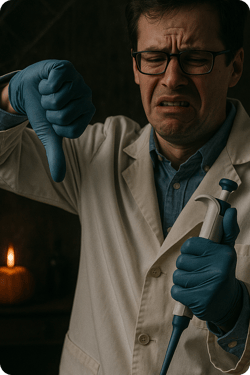 Like a ghostly curse latching onto your wrist and creeping up your elbow, cumulative strain from pipetting can afflict even the hardiest lab warrior.
- In older studies, pipetting strain on the thumb has been assessed: one paper noted that prolonged use of automatic pipettes exerts high strain especially in users with lower muscle strength, and symptoms increase with time spent pipetting[4]
- An ergonomic review evaluated ten single-channel pipettes and found that features such as low tip-ejection force, balanced design and low blowout force correlate with better comfort and usability[5]
- Epidemiological surveys report increased incidence of elbow or hand complaints among pipette users, especially when continuous pipetting exceeds 60 minutes[6]
Tips to ward off the curse:
- Rotate tasks so pipetting is interspersed with non-manual operations
- Select pipettes with ergonomically optimized design (lightweight, good balance, low ejection force)
- If huge volume of pipetting is required, consider semi-automation or electronic pipettes
- Maintain neutral wrist posture: avoid extreme flexion or extension, and avoid twisting
- Use adjustable height benches and chairs so arms are parallel to the workstation
- Periodically stretch hands, fingers and forearms; take microbreaks
Final Thoughts: From A Haunted Lab to Safe Haven
Working in the lab doesn’t have to be a Halloween horror show. With rigorous attention to contamination control, thoughtful pipetting technique and ergonomic best practices, you can avoid the specters of ruined runs, phantom amplifications and lab-acquired mutant strains.
Frequently Asked Questions (FAQ)
What is the most common cause of lab contamination, and how can I prevent it?
The majority of cross-contamination incidents stem from aerosols and liquid carryover during pipetting. To prevent this: use aerosol-resistant filter tips for sensitive assays (PCR, qPCR, sequencing), avoid forceful aspiration or blow-out, keep tubes closed whenever possible, physically separate pre- and post-amplification areas, according to CDC biosafety guidance, minimizing aerosol generation and maintaining workflow segregation are key to contamination control.
Can pipettes themselves become contaminated?
Yes. Over time, pipettes can accumulate residues or aerosols inside the shaft or piston. This can cause cross-contamination and affect accuracy. Regular internal cleaning, preventive maintenance, and ISO 8655 calibration help maintain integrity and performance. Pipette.com offers accredited calibration services to ensure your instruments meet quality standards.
How do filter tips reduce contamination risk?
Filter (barrier) tips contain a hydrophobic membrane that prevents aerosols and liquids from entering the pipette body. This protects both the sample and the instrument. Studies confirm that filter tips significantly reduce contamination and infection risk in molecular and microbiological workflows. While not a substitute for proper technique, they are highly recommended for sensitive or high-throughput assays.
What are the best practices for preventing ruined assays or failed runs?
- Use new tips between each sample
- Calibrate pipettes regularly to maintain accuracy and precision
- Prepare master mixes before adding templates to reduce exposure
- Keep reagents sealed when not in use
- Use separate pipettes for pre- and post-PCR work
- Routine validation and careful pipetting can prevent failed assays and reduce costly rework
How can I reduce hand strain and improve ergonomics during pipetting?
Extended pipetting can lead to repetitive strain injuries and fatigue. Ergonomic studies show that low ejection force, balanced weight, and neutral wrist posture reduce discomfort and muscle load.
To maintain comfort and safety:
- Choose ergonomic or electronic pipettes
- Adjust bench height so arms remain parallel to the surface
- Take short breaks every 30–60 minutes
- Alternate tasks to avoid repetitive motions
References
- Contamination-pipetting: relative efficiency of filter tips compared to Microman® positive displacement pipette
- Revisiting the Micropipetting Techniques in Biomedical Sciences: A Fundamental Prerequisite in Good Laboratory Practice
- Biosafety In The Laboratory: Prudent Practices for the Handling and Disposal of Infectious Materials
- Laboratory work with automatic pipettes: a study on how pipetting affects the thumb
- Ergonomic evaluation of ten single-channel pipettes
- A questionnaire survey of the ergonomic problems associated with pipettes and their usage with specific reference to work-related upper limb disorders