If you have ever checked the tape first before pulling a wrapped instrument pack from an autoclave, you already performed one of the simplest and most widespread quality checks in sterilization. According to the CDC’s Guideline for Disinfection and Sterilization in Healthcare Facilities, chemical indicators like autoclave tape are “convenient, inexpensive and indicate that the item has been exposed to the sterilization process”[1]. But understanding what that color change actually means (and what it does not mean) is essential for building reliable sterility assurance into your daily lab, clinic or production routines.
This guide explains:
-
how an autoclave tape indicator works,
-
what its color change confirms,
-
how to use it correctly alongside other monitoring tools,
-
and where it fits within the internationally recognized hierarchy of sterilization indicators.
What Is an Autoclave Tape Indicator?
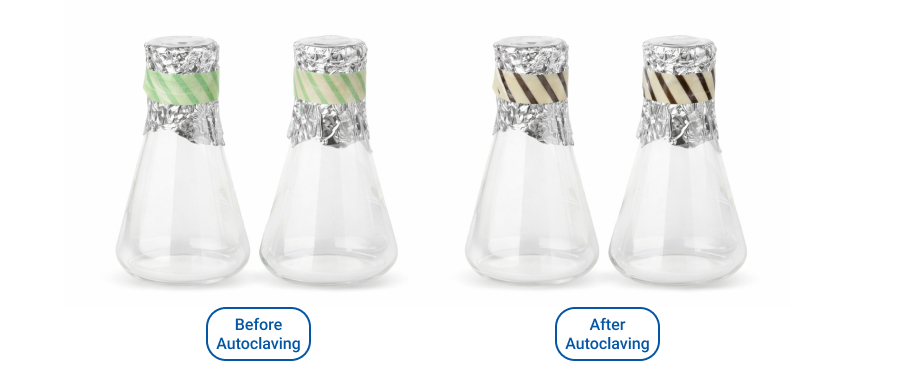
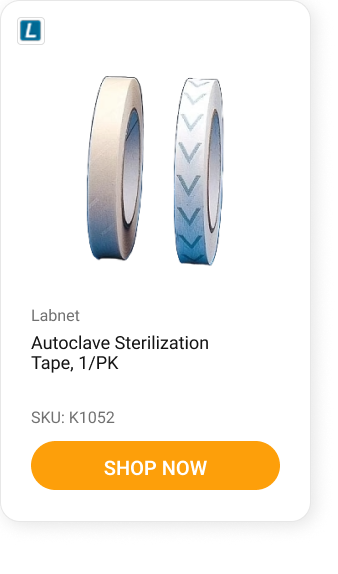
An autoclave tape indicator is a pressure-sensitive adhesive tape printed with chemical indicator markings (most often diagonal stripes) that change color when exposed to specific sterilization conditions. It is classified as a Type 1 process indicator under ISO 11140-1:2014 - the international standard that governs chemical indicators used in sterilization of healthcare products[2]. The tape is typically applied to the outside of wrapped packs, trays or containers before autoclaving.
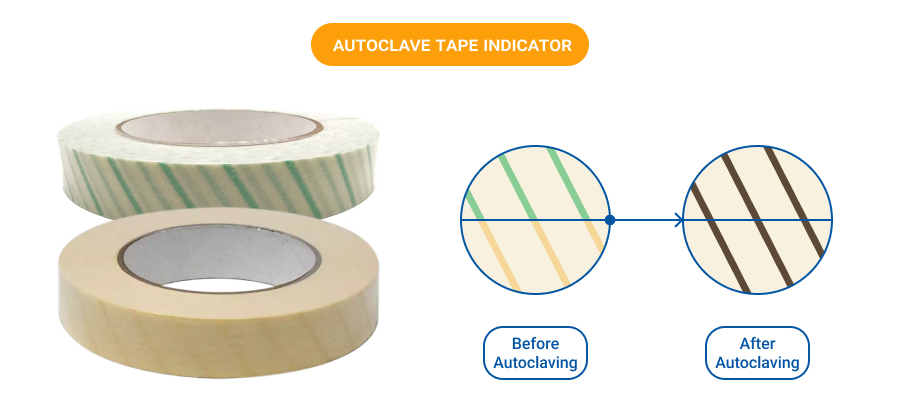
The purpose is using autoclave tape indicators is straightforward - provide an immediate visual cue that the item has been processed through the autoclave and exposed to the cycle conditions required to trigger the tape’s chemical ink. In busy labs and clinical settings, this visual shorthand is invaluable for separating processed from unprocessed items at a glance.
How an Autoclave Tape Indicator Works
The printed stripes on autoclave tape contain a chemical indicator ink formulated to react when it experiences a specific combination of sterilization parameters:
- Heat – the elevated temperature inside the autoclave chamber
- Steam (moisture) – saturated steam is the actual sterilizing agent in moist-heat sterilization
- Time – sustained exposure at the target temperature
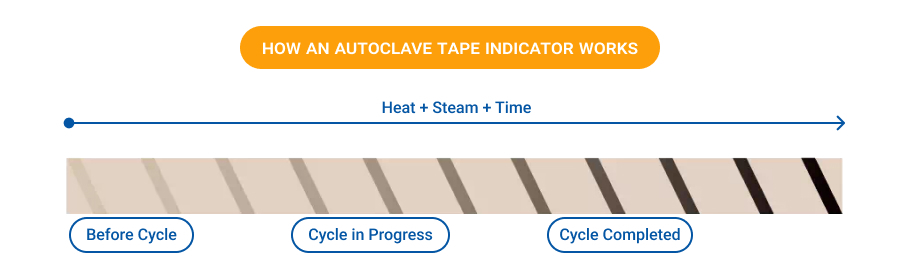
During a standard steam sterilization cycle, the autoclave heats the chamber, removes air (depending on cycle type) and holds items at a set temperature for a set time. When the tape’s indicator ink reaches its reaction threshold, it changes color, commonly from a lighter color to dark brown/black (exact colors vary by manufacturer).
Why Tape Changes Color
The color change occurs because the indicator ink contains heat-sensitive chemical compounds that undergo an irreversible reaction once exposed to consistent conditions within a steam sterilization cycle. If the tape shows a clear, complete color change, it was exposed to the sterilization environment long enough for the ink to react. If there is no color change (or only a partial one) that signals that the item may not have been exposed to the expected conditions, and the load should be investigated[3].
Because autoclave tape is a Type 1 indicator, its reaction threshold is deliberately set to be reached relatively easily. It is designed to respond to a single sterilization parameter (or a broad combination) rather than to confirm that all critical variables were met simultaneously. This is precisely why it serves as a process indicator - a quick pass or fail flag - rather than a sterility guarantee[4].
%20Long.png?width=338&height=574&name=Nevs%20Ink%20Autoclave%20Leaded%20Tape%203-4_%20Wide%20x%202160_%20(60%20yrds)%20Long.png) |
%20Long.png?width=338&height=574&name=Nevs%20Ink%20Autoclave%20Lead%20Free%20Tape%2c%201_%20Wide%20x%202160_%20(60%20yrds)%20Long.png) |
 |
 |
What an Autoclave Tape Indicator Confirms
Used correctly, an autoclave tape indicator confirms three practical things[5]:
- The pack went through a cycle: It helps distinguish processed from unprocessed items in busy workflows in a simple but critical sorting function
- The outside of the pack was exposed to the autoclave environment: The tape reacted to heat and steam exposure at the specific location where it was placed
- A gross failure may have occurred if the tape did not change: If the tape looks unchanged after a cycle, you have a clear reason to investigate: wrong cycle selected, interrupted run, tape applied incorrectly or insufficient exposure
In practical terms, autoclave tape is an excellent process indicator. The CDC describes chemical indicators as tools that “indicate that the item has been exposed to the sterilization process,” which is exactly what an autoclave tape indicator does at the external pack level.
What an Autoclave Tape Indicator Does NOT Confirm
This is the section that matters most for sterility assurance. An autoclave tape indicator does not prove that the contents of a pack are sterile[5]. Specifically, it does not confirm:
- Sterility inside the pack – The tape sits on the outside surface and cannot indicate conditions within
- Adequate steam penetration to the center of the load – air pockets, dense wrapping or overloading can block steam from reaching instruments deep inside a pack
- Correct temperature and time were achieved everywhere in the chamber – hot spots, cold spots and loading patterns affect uniformity
- Microorganisms were actually killed – only biological indicators (spore tests) can confirm full microbial lethality[1]
- The pack remained sterile after the cycle – wet packs, torn wraps and improper storage can compromise sterility post-processing
A pack can display a perfect tape color change and still be non-sterile if the load was overpacked, the wrap was too dense, air pockets prevented steam penetration or the cycle parameters were incorrect for that load type. As the CDC’s sterilization monitoring guidance for dental settings emphasizes, an external chemical indicator alone should not be used to determine whether items are sterile[5]. This is why tape is a single layer in a broader monitoring system and never the only one.
Types of Sterilization Indicators and Where Tape Fits
Sterilization monitoring works best as a layered system. The CDC recommends that “the sterilization procedure should be monitored routinely by using a combination of mechanical, chemical and biological indicators”[1]. Think of these as a ladder of increasing confidence:
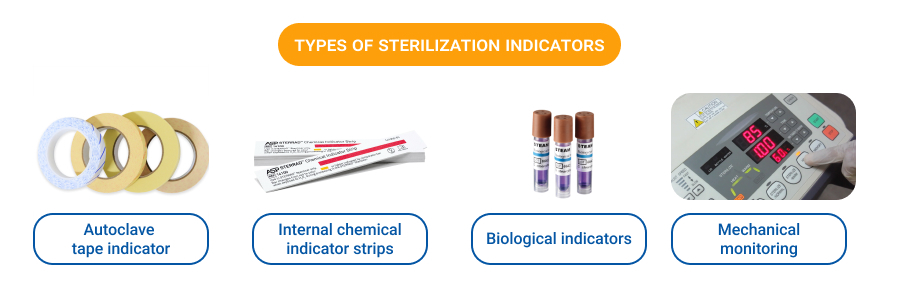
- Autoclave tape indicator (external chemical indicator / Type 1): Shows that the outside of the pack was exposed to an autoclave environment. Quick, visual, at-a-glance identification
- Internal chemical indicator strips or integrators (Types 3–6): Placed inside packs to indicate whether conditions inside the package reached the required parameters. Type 5 (integrating) and Type 6 (emulating) indicators respond to all critical sterilization variables and provide stronger evidence than external tape alone
- Biological indicators (spore tests): The strongest confirmation available. Biological indicators contain highly resistant bacterial spores (typically Geobacillus stearothermophilus for steam sterilization) and directly test whether the sterilizer killed those organisms. The CDC identifies biological indicators as “the most accepted means of monitoring the sterilization process”
- Mechanical monitoring: Autoclave printouts and digital logs recording time, temperature and pressure for each cycle. These provide continuous, objective data and should be reviewed every load[6]
The ISO 11140-1 classification system defines six types of chemical indicators and the numbering does not imply a hierarchy of quality, but reflects different intended uses. A Type 1 indicator (tape) is not “worse” than a Type 5; it simply serves a different purpose in the monitoring workflow. Understanding this distinction helps teams select the right indicator for each checkpoint rather than over-relying on a single type.
How to Use an Autoclave Tape Indicator Correctly
Small technique choices can make tape more reliable and easier to interpret. The following best practices are drawn from CDC guidance[5], ANSI recommendations[4] and industry educational resources[3].
1. Apply Tape to a Clean, Dry Surface
If a wrap is damp or dusty, adhesion can fail and the tape may peel during the cycle. Poor adhesion also makes results harder to interpret because partial contact with the surface can cause uneven color development.
2. Place Tape Where It Is Visible After Processing
Position the autoclave tape indicator so that it can be checked without turning a hot pack multiple times. This reduces handling, speeds up workflow and lowers the risk of contaminating the pack surface through excessive contact.
3. Do Not Use Tape to “Seal Sterility” by Itself
Tape helps keep wraps closed and identifies processed items, but it is not a sterile barrier system on its own. The wrap or rigid container is the barrier; tape supports closure and serves as an indicator. For proper sterile barrier guidance, refer to ANSI/AAMIST79[4].
4. Use the Right Tape for the Right Cycle
Steam indicator tape is formulated specifically for steam (moist heat) sterilization. If your facility also uses dry heat, ethylene oxide (EO), hydrogen peroxide or other low-temperature processes, each requires its own dedicated indicator tape or chemical indicator. Using steam tape in a dry-heat oven, for example, may produce misleading results.
5. Check the Color Change Against Your Lab’s Acceptance Criteria
Some tapes change from light to dark with clearly defined stripes; others shift more subtly. Train all staff on what a “passed” result looks like for the specific brand and lot of tape your lab uses. Document the acceptance criteria in your standard operating procedure (SOP) so it is consistent across shifts and personnel.
6. Store Tape Properly
Chemical indicator inks can degrade if stored in excessive heat, humidity or direct sunlight. Keep tape sealed in its original packaging, store it in a dry environment within the manufacturer’s recommended temperature range and observe shelf-life dates. Expired or improperly stored tape can give inaccurate readings.
Common Reasons Tape Does Not Change (or Changes Poorly)
If your autoclave tape indicator looks unchanged or only partially changed after a cycle, do not try to guess why but investigate. Common causes include:
- Wrong cycle selected, or a cycle interruption before the hold phase completed
- Autoclave not reaching target temperature or pressure (mechanical fault)
- Tape placed in a location with poor steam exposure (rare, but possible in unusually configured loads)
- Expired or improperly stored tape whose indicator ink has degraded
- Excessive moisture or wrap issues affecting the readability of the color change
- A non-steam process (dry heat, EO) or low-temperature cycle used with steam-specific tape
When in doubt, quarantine and reprocess the load. Document the event according to your SOP and review the autoclave’s mechanical printout or digital log to identify the root cause.
Best Practice: Combine Tape with an Internal Indicator
For routine loads, many labs and clinics pair external and internal monitoring as recommended by the CDC[4] and ANSI[5]:
- Autoclave tape on the outside – quick confirmation that the pack was processed
- Internal chemical indicator (Type 4, 5, or 6) inside each pack – verifies that sterilization conditions were reached inside the package, where the instruments actually are
- Scheduled biological indicator testing – ongoing validation that the autoclave is actually killing resistant organisms. The CDC recommends spore testing at least weekly; AAMI ST79 recommends it with every load for the highest assurance
- Mechanical monitoring every load – review the autoclave’s cycle printout or digital record for time, temperature and pressure
This layered approach transforms the tape from a simple label into a meaningful first checkpoint within a compliant, repeatable sterility workflow. As STERIS notes in their sterility assurance guidance, no single type of indicator should be used alone to make load-release decisions as evaluating all available monitoring results together provides the strongest assurance.
Find the Right Autoclave Tape Indicator for Your Lab
An autoclave tape indicator is a fast, practical way to show that a pack has been exposed to a steam sterilization cycle. It helps you quickly separate processed from unprocessed items and spot obvious failures at a glance. Just keep its role in context: the tape confirms exposure where it is placed, not sterility inside the pack.
For stronger quality control, use autoclave tape together with internal indicators, biological testing, mechanical monitoring and proper loading practices. When you are ready to restock, explore offers at Pipette.com to find the right Autoclave Tape Indicator and other sterilization supplies to support consistent, compliant lab workflows.
|
|
|
|
Frequently Asked Questions (FAQ)
Q: Does a color change on autoclave tape mean my instruments are sterile?
A color change confirms that the outside of the pack was exposed to conditions consistent with a steam sterilization cycle. It does not confirm sterility inside the pack, adequate steam penetration or microbial kill. For sterility confirmation, you need internal chemical indicators and biological indicators as part of a layered monitoring system.
Q: How often should I use biological indicators (spore tests) in addition to tape?
The CDC recommends biological indicator testing at least weekly for each sterilizer. AAMI ST79 goes further, recommending biological monitoring with every load for the highest level of assurance.
Q: Can I use steam autoclave tape for dry-heat or ethylene oxide (EO) sterilization?
Steam indicator tape is formulated to react to the specific combination of heat, moisture and time present in steam sterilization. Using it in a dry-heat oven or EO sterilizer can produce misleading results - either no change or a false positive. Always use the indicator type matched to your sterilization method.
Q: What is the difference between Type 1 and Type 5 chemical indicators?
Under ISO 11140-1, Type 1 indicators (autoclave tape) are external process indicators designed to show that a pack was exposed to a sterilization process. Type 5 indicators are integrating indicators that respond to all critical sterilization variables (time, temperature and steam) and are designed to correlate with biological indicator performance. Type 5 indicators are placed inside packs and provide much stronger evidence that conditions throughout the pack met sterilization requirements.
Q: My tape only partially changed color. Should I consider the load sterile?
A partial or unclear color change is a reason to investigate, not to accept the load. Check the autoclave’s mechanical printout for cycle completion, verify the tape was not expired or improperly stored and ensure the pack was positioned to allow proper steam exposure. When in doubt, quarantine and reprocess the load.
Q: Why is an internal chemical indicator needed if I already use tape on the outside?
External tape only confirms conditions at the pack’s outer surface. Steam must penetrate through the wrapping to reach the instruments inside, and barriers like dense packing, air pockets or heavy loads can prevent this. An internal chemical indicator placed among the instruments directly shows whether sterilization conditions were achieved where it matters most, which is inside the pack.
List of References:
- CDC/HICPAC - Guideline for Disinfection and Sterilization in Healthcare Facilities — Sterilizing Practices
- STERIS Life Sciences - 6 ISO Types of Chemical Indicators for Steam Sterilization
- STERIS Healthcare - What is Sterility Assurance Monitoring?
- American National Standards Institute - Comprehensive Guide to Steam Sterilization and Sterility Assurance in Health Care Facilities
- CDC - Best Practices for Sterilization Monitoring in Dental Settings
- World Health Organization - Decontamination and Reprocessing of Medical Devices for Health-care Facilities